Flight is harder to fake in wood than swimming, and the pieces that manage it share a trick: a slim rod or a set of thin wires holds the figure in the air, and wires or a small motor move the wings. The MoveArtly sky collection has four flying pieces, a round little bird, a swan, a flying pig and a dragon, plus a whale that floats. This guide walks through each, with how it moves and what it costs. Prices are the live prices on 27 October 2026.
A little bird that beats its wings
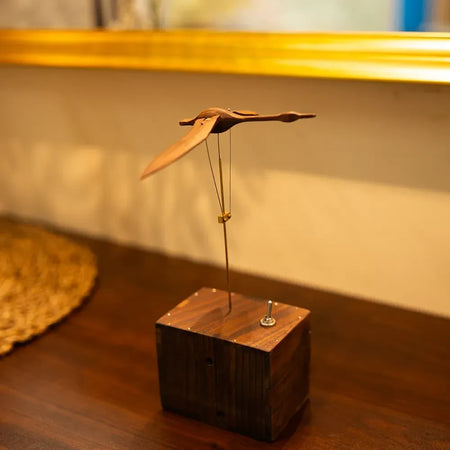
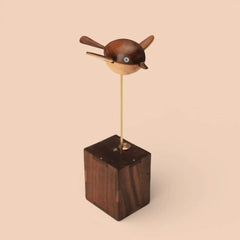
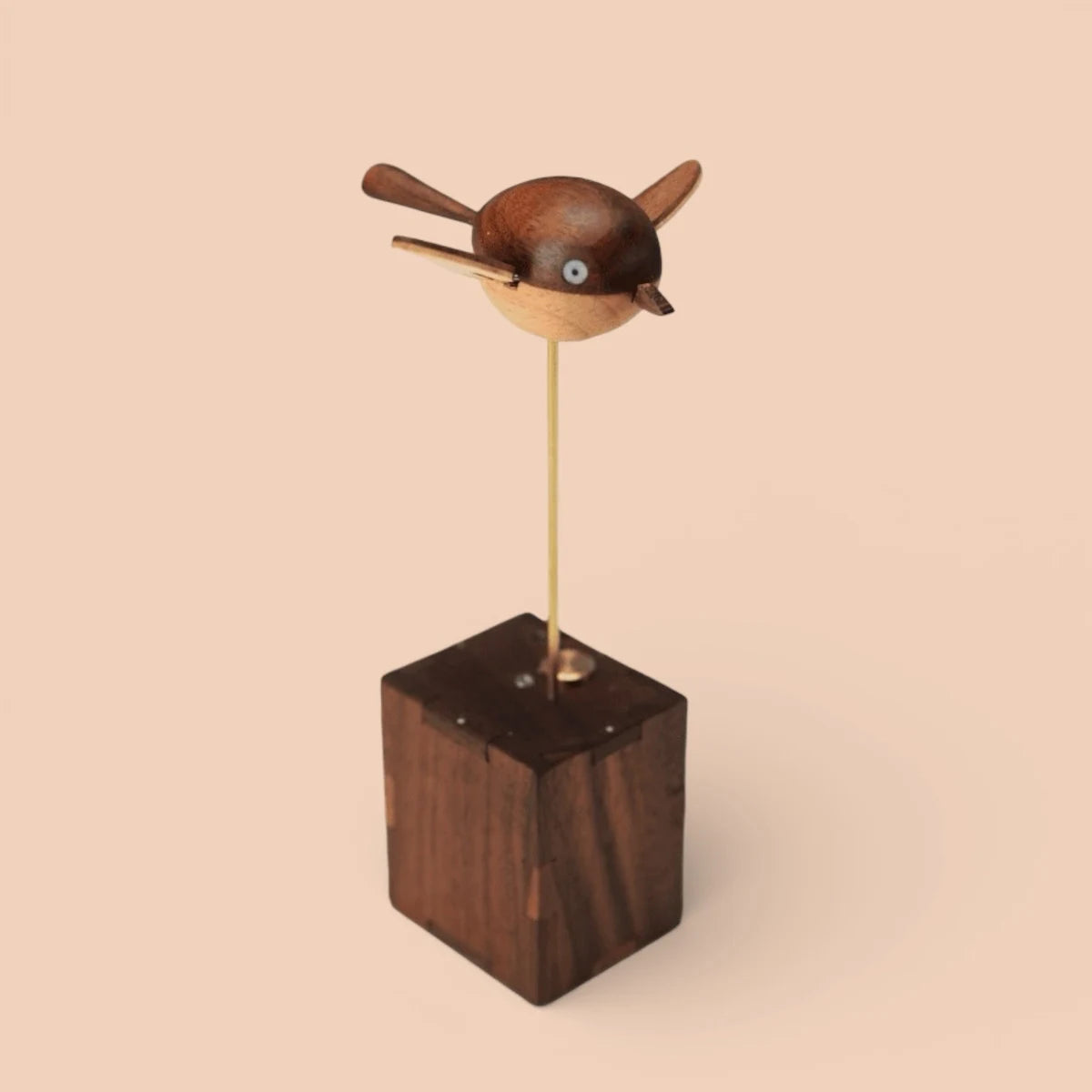
Pipwing, $129, is a round little wooden bird that beats its wings on a slim brass rod above a small dark wood box. A small motor in the box moves the rod, and the rod drives the two wings up and down. A touch on the brass button on top starts it and steps through three speeds, from a slow flutter to a busy buzz. It is rechargeable, the charging cable is in the box, and its page says it is small enough to sit next to a keyboard, which makes it an easy first automaton.
A swan that never hurries
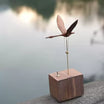
Lakesong is a dark wood swan with two long wings that rise and fall on thin wires above a small dark wood box, with a slim brass rod holding the bird up as if it were flying over your desk. Nothing touches the wings directly: a fine wire runs up into the body, and one small pull from below raises both wings together. It costs $119, or $129 with a music box, runs on one AAA battery (not included) and measures 12 x 8.5 x 20 cm (4.7 x 3.3 x 7.9 in). Its page suggests it for weddings, anniversaries and bird lovers.
When pigs fly
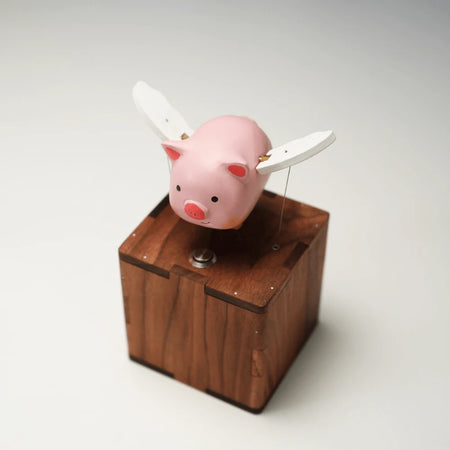
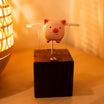
Skyhog, $109, is the lowest-priced piece in the collection, and the most light-hearted. A small pink pig with two white wings hangs on thin wires above a wooden box, held in the air by a slim metal rod, and thin wires run from the top of the box up to the wings. A small metal button on top starts it. It takes two AAA batteries (not included, so add some if it is a gift) and fits on a desk or a shelf. It is aimed at pig lovers and anyone who likes the phrase when pigs fly.
A dragon that folds its wings
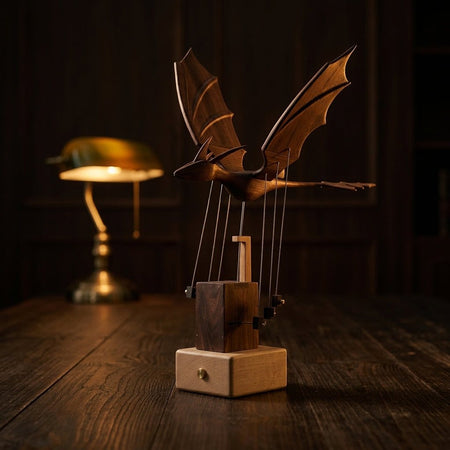
Wyvernwood is the dragon of the group. Wide ribbed wings lift and fold on thin wires above a dark wood tower, and its page puts it in plain terms: a dragon that glides instead of roars. A small motor turns a shaft, the wires carry the turn up to the wings, and each wire pulls at a slightly different moment, which is why the wings fold instead of flapping like a toy. It is powered over USB-C. The two editions, pale wood at $209 and dark wood at $219, differ only in look, and the page says the mechanism is the same in each. See our dark and pale wood guide for the difference between the two woods.
A whale that floats
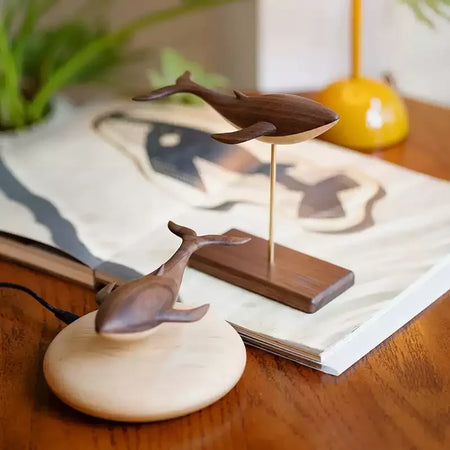
Not every flying piece uses wires. In the Levitating edition of Floatfin, magnets in a round pale wood base and in a carved dark wood whale push against each other, and the base keeps that push steady so the whale stays up in the air. It costs $199 and the base plugs in. The Standing edition, $129, puts the same whale on a slim brass rod above a dark wood stand and needs no power.
How the flying pieces compare
- Lowest price: Skyhog, $109.
- Easy to start: Pipwing, with one touch of a brass button and three speeds.
- For a calm desk: Lakesong, with long dark wood wings and an optional music box.
- For a centerpiece: Wyvernwood, the dragon, from $209.
- No wires and no visible support: the Levitating edition of Floatfin, $199.
Why a rod and wires suit flight
A figure cannot hang in the air without something to hold it, and the simplest fix is a slim rod. The rod gives the bird, swan or pig a fixed point, so the wings can move freely around it. In Skyhog a slim metal rod holds the pig up while wires work the wings, in Lakesong a brass rod holds the swan while a fine wire raises both wings together, and in Pipwing a brass rod above the box is the part the motor moves to beat the wings. Our guide to how wooden automata work explains each of these parts in more detail.
Power and setup for the flying pieces
- Pipwing: rechargeable, with a charging cable in the box.
- Lakesong: one AAA battery, not included.
- Skyhog: two AAA batteries, not included.
- Wyvernwood: a small motor, powered over USB-C.
- Floatfin: the Levitating base plugs in, and the Standing edition needs no power.
Give wired and winged pieces a little clear space so nothing brushes them while they move, and see our setup and care guide for starting, placing and caring for each one.
Prefer land animals?
If wings are not your thing, the field collection has two wooden horses. Farstride, $159, runs in place on two slim rods above a round wooden base, and every leg is a chain of small wooden links pinned together. Canterwood, $329, walks, joint by joint, with every leg joint held by a small metal pin you can see from the outside.
Want to know how the wires, rods and cams actually work? Read How Wooden Automata Work. Setting one up? Our setup and care guide covers power and starting each piece. Buying for someone? The gift guide sorts every piece by recipient and budget. For the sea, see our guide to ocean wooden automata, or browse the full MoveArtly collection.